Dreaming Mexican Art

Three years had passed since I had been to Spain (Valencia). It would be months until I got to Mexico, the city. In the middle, I dreamt of a building that could not exist. A surviving Roman complex converted to a mosque, slicked by blue-tiles, struck by a dome, crowned by pediments. Above its old world ornaments, an intrusion of Nahua glyphs. Entering from a side chapel, a partial view of the interior emerged, but it was dark, crowded, and inaccessible. The walls of my room at the time were covered with Mexica paraphernalia, and I was churning through an obsession with Spain’s heritage: Muslim, Christian, and Jewish poets, mystics, and scholars speaking to each other across time. The room itself, cinderblocked within a shuttered sorority house turned Jewish fraternity repatriated or recolonized by pseudo Latinos and other holdovers led on by promise, like Al Andalus or Mexico, was a case study in the dust and dreams left behind by that fateless, not even tragic, churning of bodies across diversity over time. The stimulation of my waking setting could not have fully authored the dream. Christians destroyed or converted all Valencia’s mosques. Valencia, under the kingdom of Aragon not Castille, was one coast and crown away from the spoils of colonization. The dream obeyed a different timeline than the one occupied. The image stays with me today.
In Houston, I happened upon a book that I had found years ago in a used bookstore, Art of Mexico. In those pages I first encountered the word tequitqui, the term for a distinctly Mexican mode of expressing sublimity in the early colonial period. The word descended from the Nahuatl tequitl (meaning tribute, tax, labor) and named a style in which indigenous artisans, newly subordinated to European iconographic programs, carved and painted a Christianity refracted through their own cosmologies. Such resonances included the glyph of Coatlicue hidden beneath la Virgin de Guadalupe. Teonanacatl, the flesh of the gods, hidden in the Eucharist. Filipino tiles in Puebla. A gesture of participation and resistance. The right hand not knowing what the left hand is doing. The stakes of naming this word are ethical, not merely ornamental. Calling Mexican art “syncretic” for blending Indigenous and European imagery is violence. To not name tequitqui for what erases an epistemology, a way of understanding the world, that arose from the origins of Mexico and other Latin American cultures.
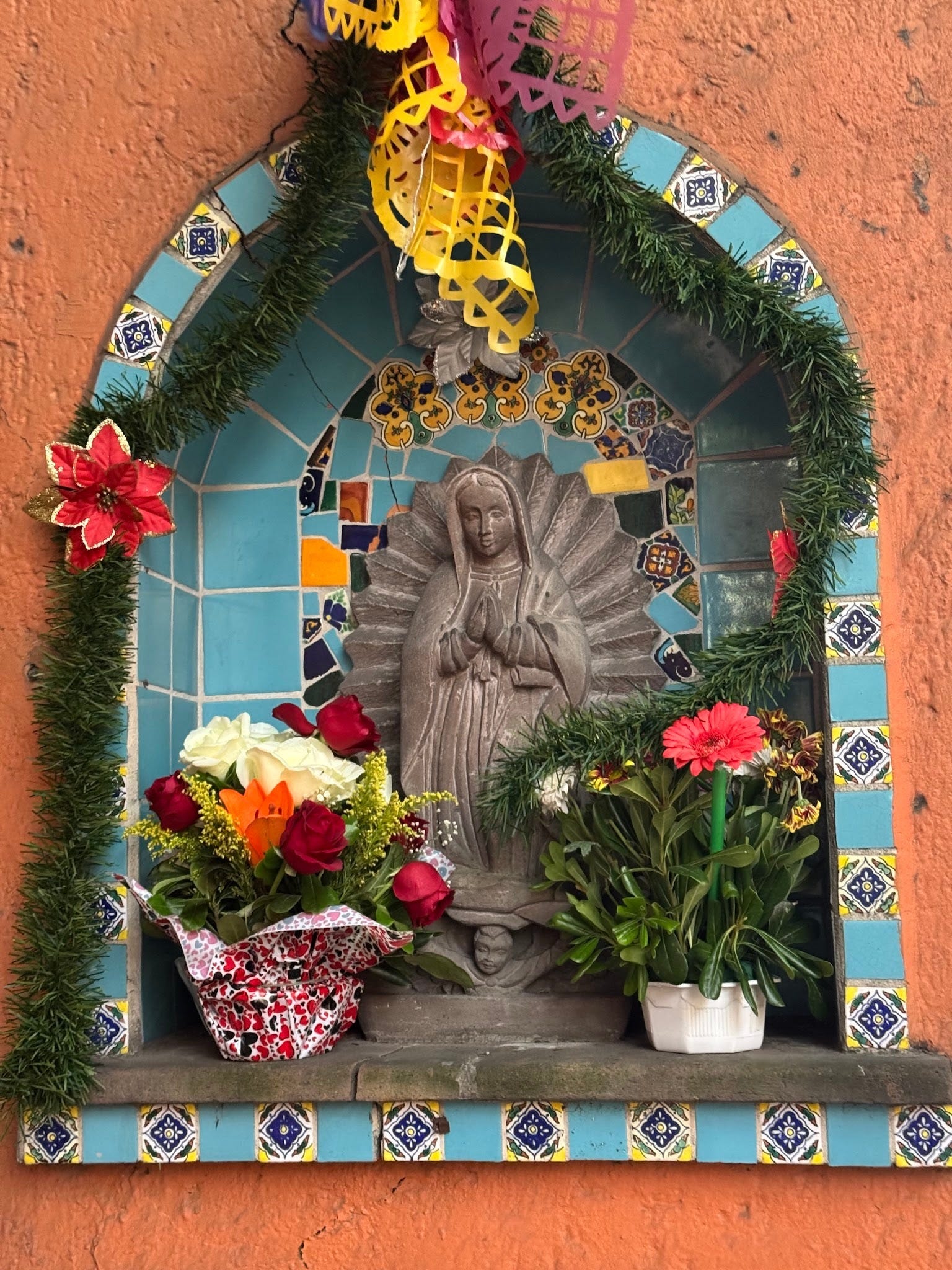
The dream’s imagery, in its looseness of historicity and linearity, was not a metaphor for any of this. It was the dancing of images across borders performed in another world.
My first week in Coyoacán, and Victoria urged me to visit the Museo de San Carmen. She was Mexican, born in San Antonio, raised in London, settled in Mexico City, a ballet instructor and mother of three. She let me stay in a room above her kitchen (through Airbnb), the one room in the house a curandero didn’t clean from haunt because he didn’t have to. According to the story, the curer put the haunt in a clay vase as a heat left the room. Nobody on Whatsapp knew where this person disappeared to after the cleansing. Victoria stressed the importance of this San Carmen. Something like, when you see it, you’ll understand. I went, and the encounter began on an arresting set of floral murals. Dense, curling stems reached into unclaimed wall-space. Petals executed a sensuality that resisted the rigid symmetry of imported Baroque. Further inside, an elaborately polychromed ceiling: yellow arabesques wounding around a central floral medallion, relief and pigment still vivid despite centuries of wear. The gore flowers were too thick, too dense to be a loyal Baroque facsimile.
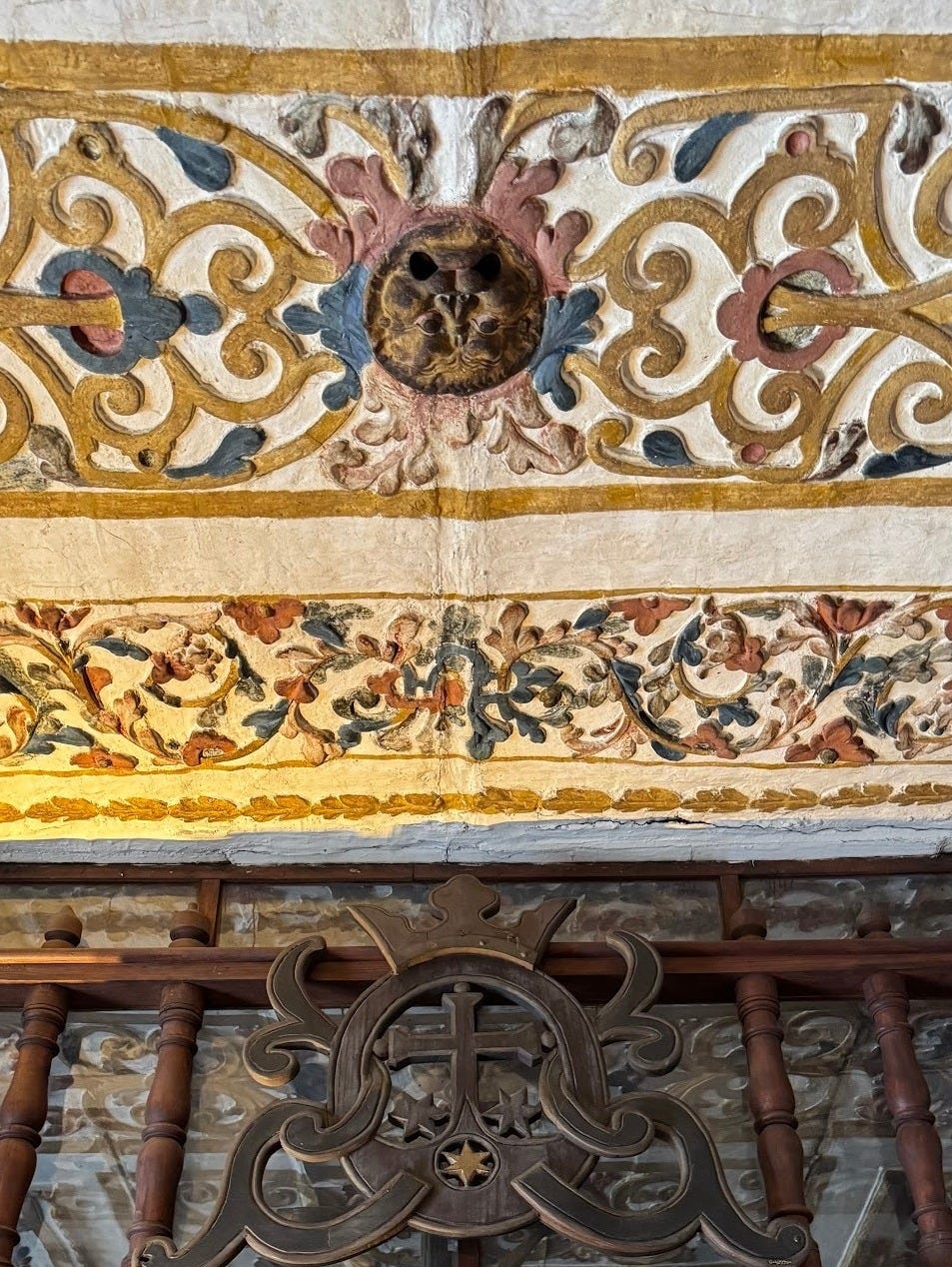
When I asked one of those unarmed museum guards (watchers?) whether these shapes were indigenous, he hesitated, tilting his head before offering that they were “Arab” in style. The attribution didn’t satisfy me, so I pressed him on the curvature of the lines and the mineral pigments. He conceded that the pigments followed prehispanic recipes. The exchange revealed a familiar pattern: the visual presence of indigenous labor and design glossed over by an imported genealogy. In Al-Andalus, “Mudéjar” denoted the work of Muslim artisans permitted to build under Christian rule. Projected onto the Mexican colonial context, the term occludes a far more violent matrix of forced conversion and labor. Calling such work Mudéjar is not simply a misattribution; it is the same epistemological violence the tequitqui mode emerged to survive — replacing the shimmering colonial wound with a peaceful and proud narrative of European stylistic continuity.
The dream’s inversion, found in waking life: instead of imagined Aztec glyphs carved into a mosque wall in Valencia, I stood before the oral projection of Middle Eastern otherness onto a convent ceiling in Mexico City. Arabe-Indio, Cristiano-Mexicano. Nahuatl on the mosque. The custodian’s attribution folded into the art of performing tequitqui across the centuries— our conversation became the marginalia of an unstable palimpsest.
But contact with tequitqui, like the custodian’s deflection intended, felt just out of reach. The dream’s resonance wobbled. I was in over my head, and had flashbacks to the wild goose chase scene in Tintin, which I had forgotten I watched as a kid. I stopped looking and went to Spanish class. In the UNAM’s volcanic rock-cut center for foreigners, in those last minutes where the evening heat tickles the bell about to ring, another hint flashed before my eyes. My spanish teacher was screensharing, and for an instant his recently searched bar showed its contents.The name rang familiar even though I had never heard it: Ex-Convento de Culhuacán. Culiacán? It sounded like Culiacán. I had to trust the niche find, anti-recommendation gleaned from nosiness and boredom. I had to trust my teacher’s taste in cultural sites: he was from Iztapalapa about to matriculate in a master’s in literature in Madrid. He must have that good taste of someone between worlds. I took an Uber after class and went to find out.
UNAM pic (show the thing) (or show the screenshot of culhuacan)
My Uber and I talked politics until it became evident that I was not an antisemite. Drop off, familiar calm the moment you walk through those gates.
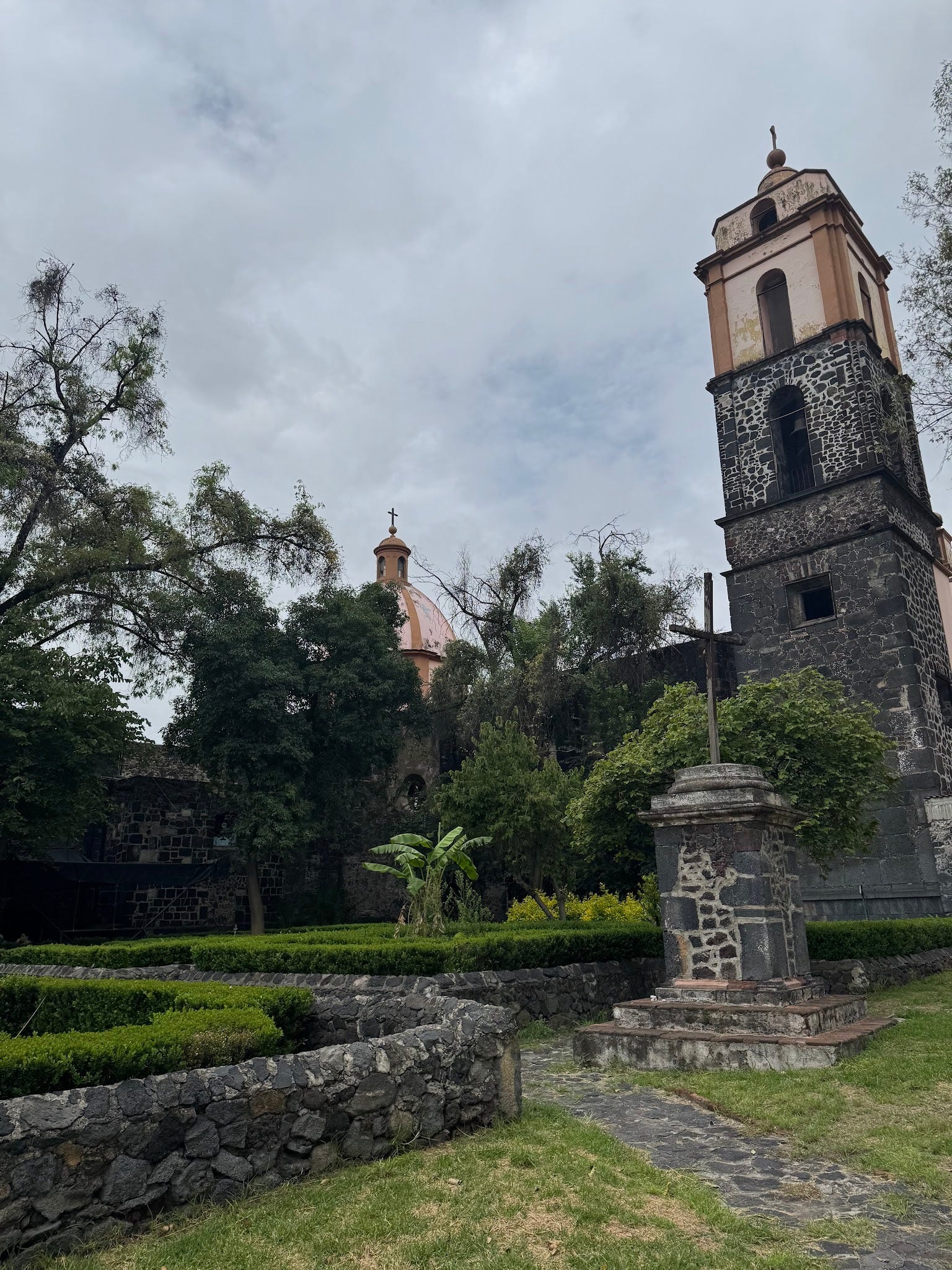
Small talk at the entryway. Here, in Culhuacán, the sensual flower motif from San Carmen was instantly apparent on the front façade of the monastery’s walls. Grotesques spread like unruly ivy. Geometric white and black patterns, a broken checkerboard, adorned the wall into the main complex. In the lobby, a ten-foot painting of St. Augustine towered over me and tiny monks on the wall. He was more like a god than a saint. Half his face had been rubbed away by time, and a single remaining eye stared into me and into the other passersby while his disciples, painted in miniature beside him, yearned for an attention he would not give them. He was more like god than a saint. I felt watched by something outside of time. From his aura I assumed it was Jesus.
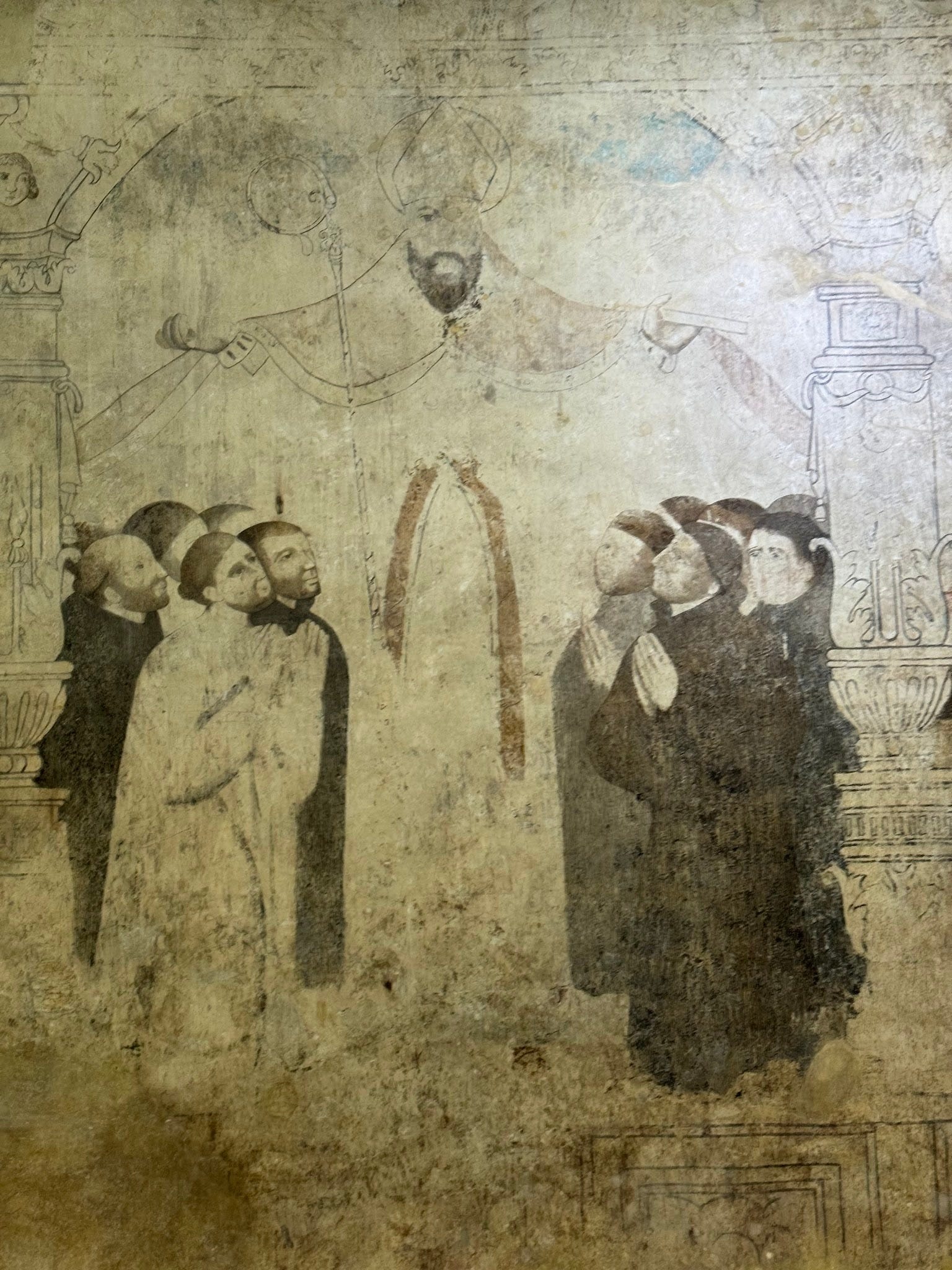
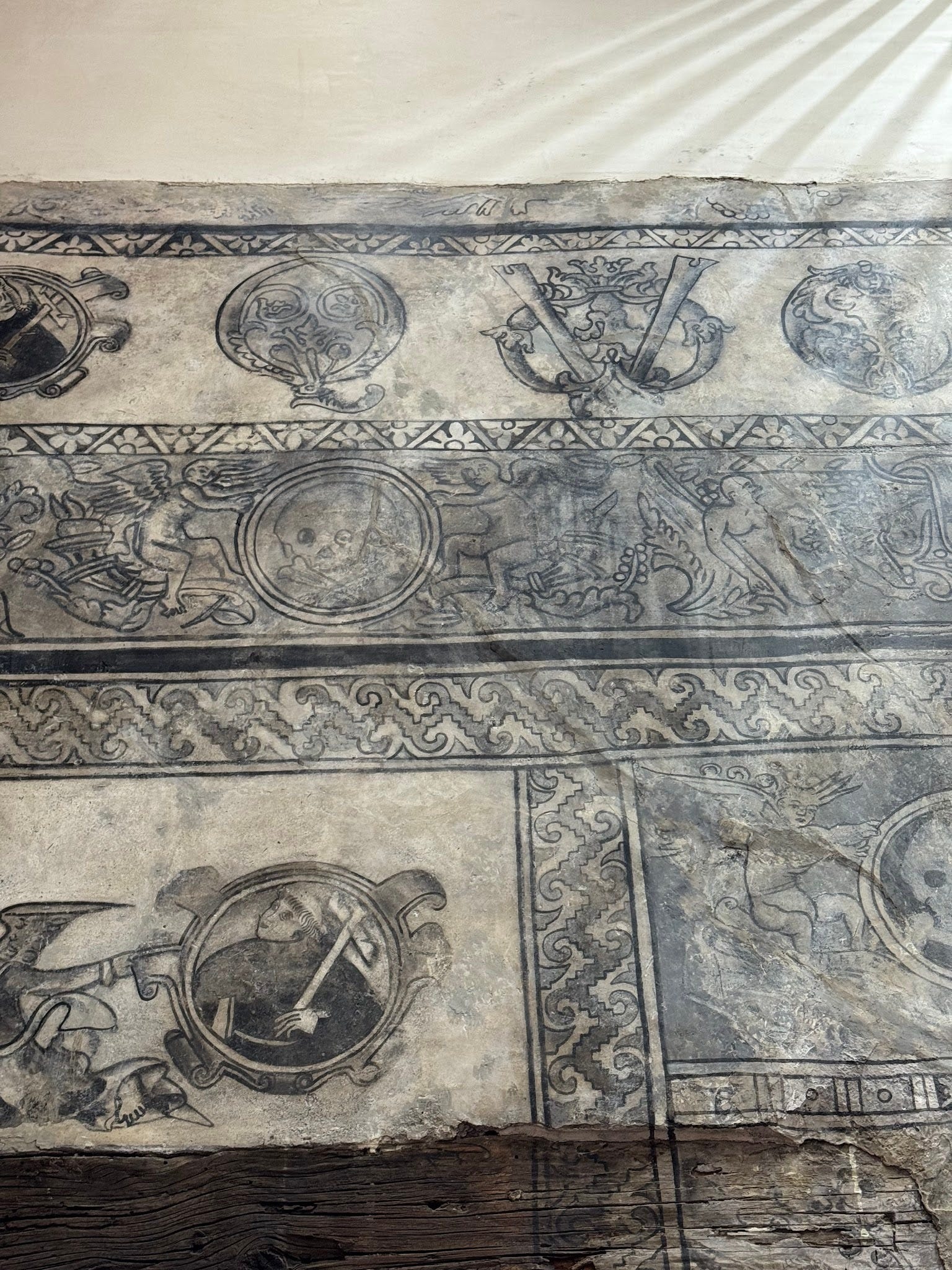
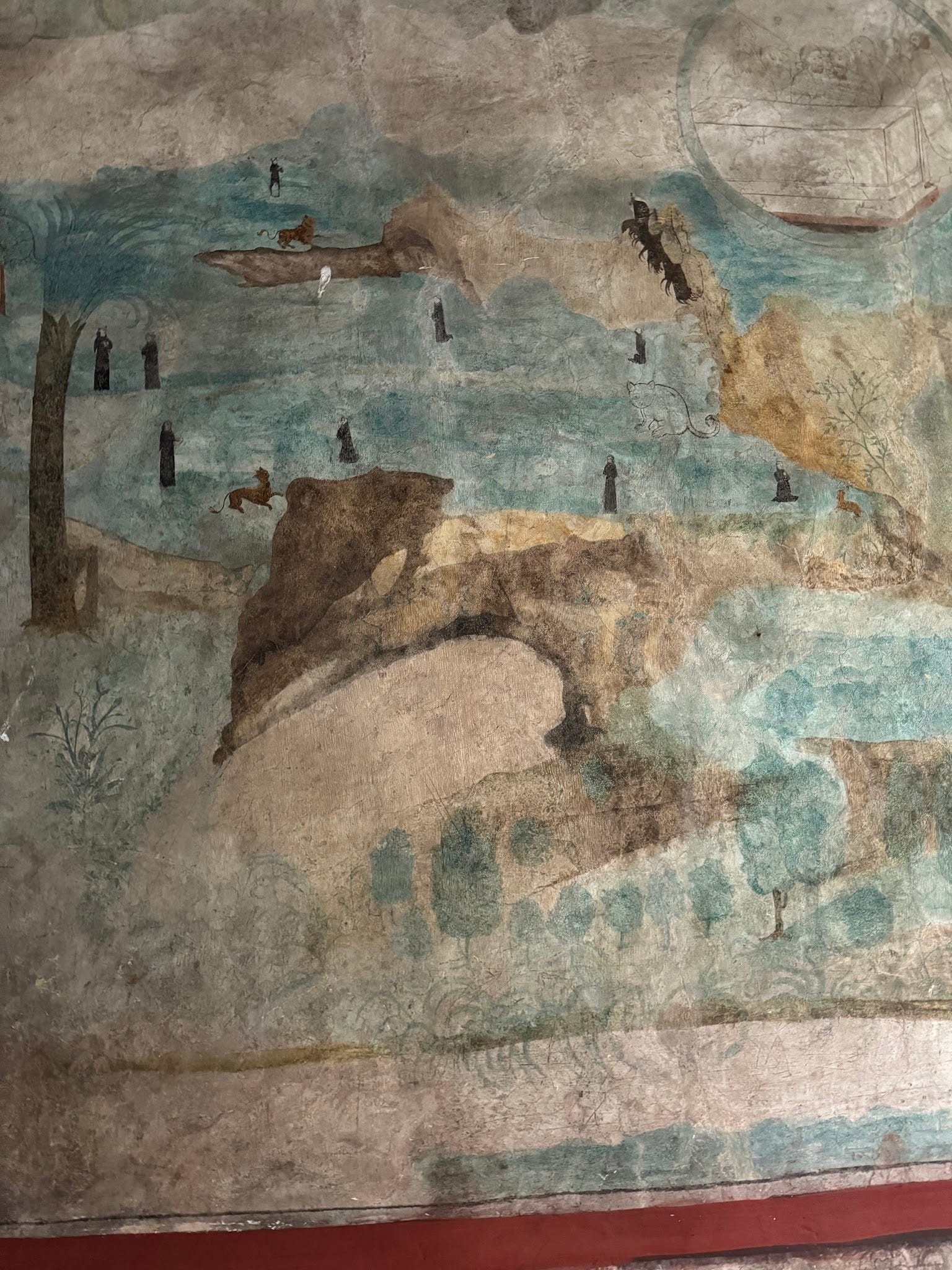
Inside, an aura of quietude. Very few tourists. Details on the walls etched with seemingly prehispanic paints breathed life into Christian motifs. One mural depicted monks in the Thebaid desert in eternal repose across a turquoise earth spotted with glyph-shaped fauna. Outside, the igneous shell of the church led into a cemetery running for acres. Upstairs, the murals sharpened into repeating Baroque patterns — a skull crossed by bones, a heart struck by arrows, a cross in a bubble held up by griffins — all framed by a lining of grecas, repeating geometrical patterns aesthetically foreign to European art yet, in this turn, encapsulating it. As I admired them, dumbstruck, I heard mariachi trumpets trail off in the distance. A handful of former friars’ cells were now reserved for INAH bureaucrats, completely unfazed by the details that stunned me. The secretary stared at me staring at the walls, taking pictures.
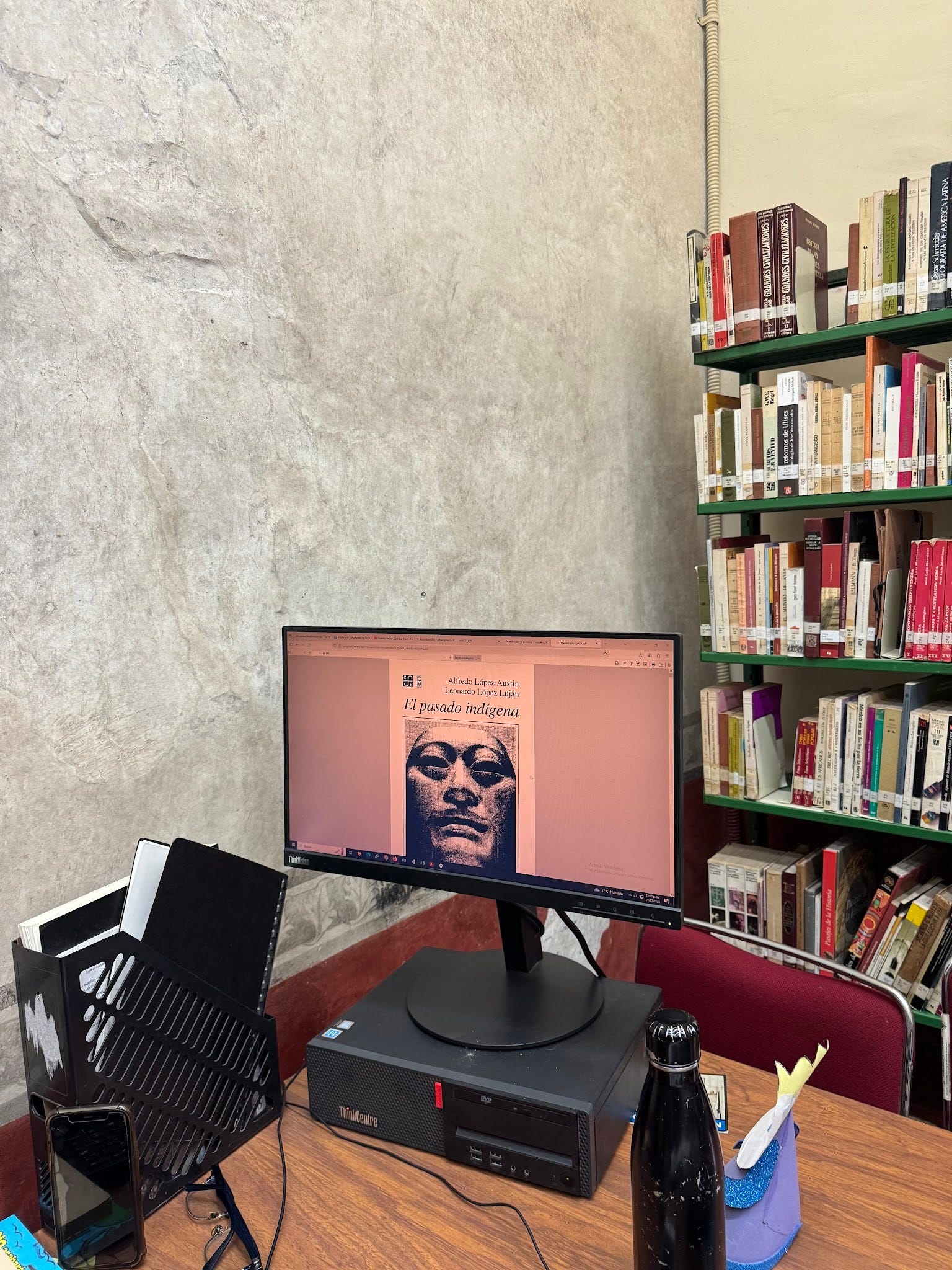
A drama was unfolding outside the community library. A working-class security guard had told an upper-class Mexican lady’s son to stop filming… it was against the rules. The lady was going over the guard’s head to the bureaucrats… The guard was commiserating with the man Adrian would later call el maestro, with a tone of unadulterated admiration I could not follow. In the next room over, Culhuacán’s prehispanic ritual items held pressure in silence. The old prestige of Mexico, pre-Mexica, pre-Tenochtitlan, made humble by time, humbling me back.
In the library I met Juan Carlos and the man I heard introduce himself as Hernán. They were scholars associated with INAH who shared in my enthusiasm. They dressed like Chicanos, but their accents were chilango. They gave me ten books. Juan Carlos, who shared my last name, laughed at the absurdity of the names in this encounter: two Ramírezes, one Cristóbal, as in Columbus, and one Hernán (like Hernan Cortés). The man I took for Hernán laughed too. He told me hay muchos méxicos. He said in a hushed tone, though there was noone else there, that a Mexican essence doesn’t exist. People living across Oaxaca, Tamaulipas, and Mexico City operate through drastically different “cosmovisiones,” and anyone who tries to forge a big one is often a vampire. Juan Carlos liked the Augustinianism about the walls, and said something about eternity in a moment, Latin backwards. The phrase struck me as off the mark. Off the mark as hell. Backwards itself. Before I caught myself and tried my best to listen. However, I said, there is something vaguely useful in conceiving of a universal mexicanismo. Everyone can recognize a Juan Gabriel song. He laughed, breaking his composure, and asked why I chose to mention Juan Gabriel. Through suddenly broken Spanish, I said it just occurred to me. He gestured toward the corridor outside the library and observed that every wall in this building era hablante. These walls spoke.
On the trip to Victoria’s house, my mind nearly gave out. I could scarcely begin to process the sheer weight of the topic I had walked into. When I closed my eyes, a montage of pre-Columbian patterns danced into form. Sober, closed eye visuals is what they call it on Erowid. What had started as a long overdue essay had become a denser knot: my ancestral fidelity and my intellectual ability were both tied at the stake. I owed it to something bigger– maybe my heritage, maybe my ancestors- to do justice to that red-hot kernel of Mexican inbetweenness and the creativity that it foams, whether in decolonized Culhuacán or diasporic Cornell. The size of the room I had walked into rent my pride and identity, morphing a middle school self-concept as someone interested in Mesoamerican history into outmaneuverable outsiderdom, unreadability to my own eyes. Culhuacán was no longer a field trip. It was a pilgrimage. And the performance it named — the one across colonized image systems perform when they refuse to dissolve, the one tequitqui has performed since the sixteenth century in pigment and stone and the joke of misheard names — did not stay outside me.
It arrived as something that came out of my hand when writing one day. It’s not a vision, not a memory, not a dream.
Jesus at the top of el Templo Mayor, explanada below cheering with the voices of the dead, the living, the unborn, et cetera. He raises the obsidian knife above Huitzilopochtli. The knife sinks into heart-flesh. Jesus looks down and sees himself. Huitzilopochtli is Jesus. There is blood pouring from the heart of both gods. The Templo Mayor convierte en un gran crucifijo. El obsidiano es un anillo, el corazón es los pies y las manos del dios. Jesús es un soldado romano. Huitzilopochtli es Jesús. Jesús es Moctezuma, Cortés lo besa como Judas. El templo mayor se disuelve en luz azul, parpadeando adentro y afuera de la existencia. El crucifijo está quemando. Grecas toltecas bailan en la piel de una capilla recién construida. Vines geométrico-florales drag it back into the maw of the earth. The sun and the moon laugh. God is a woman dying of starvation on the streets of New Spain. Night turns to day. Blood rains from the sky, lágrimas profundas desde el último cielo. The wine tastes sweet. The new cross smells like home.
first
so art history